Most homeowners never think twice about their air filter — until the HVAC system starts struggling, energy bills creep up, or someone in the house starts sneezing more than usual. By then, the filter had already been working overtime for weeks. A 4-inch deep filter like the 12x26.5x4 is engineered to last longer than standard 1-inch filters, but that doesn't mean it lasts forever — and waiting until it looks visibly dirty is often waiting too long.
In our experience manufacturing filters across hundreds of sizes, the 12x26.5x4 air filters are among the highest-performing options for whole-home filtration — but only when replaced on schedule. Knowing the specific signs that your filter is due for a change protects both your indoor air quality and your HVAC system's efficiency before problems compound.
TL;DR Quick Answers
When Should You Replace Your 12x26.5x4 Air Filters?
Standard replacement interval: Every 6–12 months for most households
Replace sooner if: You have pets, allergies, or multiple occupants
Key warning signs: Visible gray or brown discoloration, reduced airflow, increased dust on surfaces, higher energy bills, or musty odors
Rule of thumb: A 4-inch filter holds significantly more debris than a 1-inch filter — but it still has a limit
Top Takeaways
Visual inspection is your fastest diagnostic tool — dark, uniform discoloration means replacement is overdue
Reduced airflow is an early warning signal, not just an inconvenience; it strains your HVAC system
A longer filter lifespan requires tracking — set a calendar reminder to check at the 6-month mark regardless of appearance
Household conditions shorten filter life — pets, dust, and high occupancy all accelerate how quickly the media fills
Odors and worsening allergy symptoms indoors are air quality red flags worth investigating at the filter first
How to Know When Your 12x26.5x4 Filter Needs Replacing
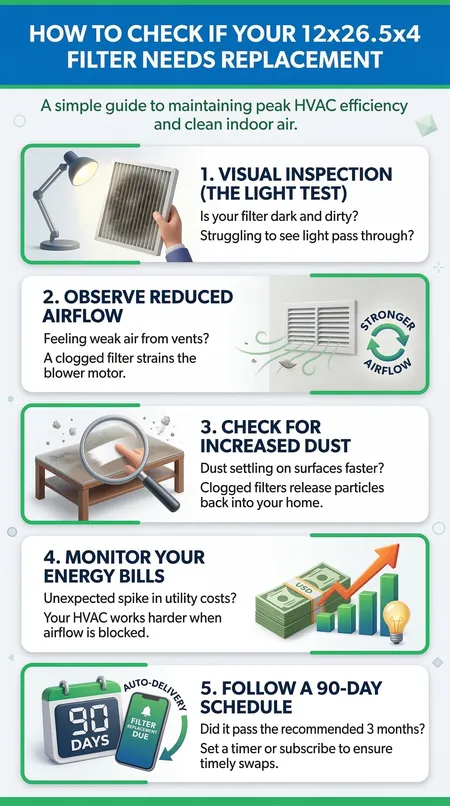
1. Look at the Filter Directly
Pull the filter and hold it up to a light source.
New filter: Light passes through clearly; media appears white or light gray
Due for replacement: Media appears dark gray, brown, or black; light is blocked
Immediate replacement needed: Visible mold, moisture, or structural collapse of the pleats
A filter that looks uniformly dark across the entire surface has reached capacity. It's no longer capturing particles — it's restricting them from passing through at all.
2. Check Airflow From Your Vents
Walk to your supply vents while the system is running.
Noticeably weak airflow is one of the earliest signals of a clogged filter
Uneven airflow between rooms can indicate the system is working harder to pull air through a restricted filter
A sudden spike in your energy bill without a change in usage often traces back to this exact problem
In our experience, homeowners frequently assume an airflow issue is a mechanical problem — when the filter is the first thing worth checking.
3. Monitor Dust Accumulation in the Home
A working air filter captures airborne particulates before they recirculate.
If dust is settling on furniture, shelves, and electronics faster than usual, your filter may no longer be trapping particles effectively
Check surfaces near return air vents specifically — dust buildup near the vent grille is a reliable early indicator
4. Notice Odors or Air Quality Changes
Musty or stale air suggests the filter media is saturated and may be harboring microbial growth
Allergy or asthma symptoms increasing indoors — when outdoor conditions haven't changed — can indicate the filter is no longer intercepting common triggers like dust mites, pollen, or pet dander
5. Track Your Last Replacement Date
12x26.5x4 air filters are rated for extended use — but "up to 12 months" is a ceiling, not a guarantee
Households with pets: replace every 6–8 months
Single-occupant homes, no pets: up to 12 months is reasonable
High-traffic homes or allergy sufferers: check at 6 months regardless
"A 4-inch filter holds roughly four times the particle load of a standard 1-inch filter — but that capacity creates a false sense of security. After years of working with homeowners, we've consistently seen that the longer replacement cycle leads people to forget entirely. The filter that lasts a year still needs to be replaced at the year mark."
Essential Resources on "12x26.5x4 Air Filters"
1. EPA: Indoor Air Quality Basics
The U.S. Environmental Protection Agency provides foundational guidance on indoor air pollutants, ventilation, and the role of filtration in protecting residential air quality.
https://www.epa.gov/indoor-air-quality-iaq
2. ASHRAE: Residential Air Filtration Standards
ASHRAE publishes the industry standards for HVAC filtration efficiency, including MERV rating methodology used to evaluate filters like the 12x26.5x4.
https://www.ashrae.org/technical-resources/filtration-and-disinfection
3. DOE: Improving Home Energy Efficiency Through HVAC Maintenance
The U.S. Department of Energy explains how regular filter replacement directly impacts HVAC energy consumption and system performance.
https://www.energy.gov/energysaver/maintaining-your-air-conditioner
4. CDC: Indoor Environmental Quality
The Centers for Disease Control and Prevention covers how indoor air pollutants affect respiratory health and the protective role of proper ventilation and filtration.
https://www.cdc.gov/niosh/topics/indoorenv/
5. ENERGY STAR: HVAC Maintenance for Homeowners
ENERGY STAR's homeowner guidance includes recommendations for filter maintenance as part of an energy-efficient HVAC operating strategy.
https://www.energystar.gov/campaign/seal_insulate/hvac
6. National Institute of Environmental Health Sciences: Allergens and Air Quality
NIEHS provides research-backed guidance on household allergens — including dust mites, pet dander, and mold — that residential air filtration helps control.
https://www.niehs.nih.gov/health/topics/agents/allergens
7. HUD: Healthy Homes Program — Air Quality
The U.S. Department of Housing and Urban Development addresses healthy home practices, including the role of HVAC maintenance and air filtration in maintaining safe residential environments.
https://www.hud.gov/program_offices/healthy_homes
Supporting Statistics
1. Americans spend approximately 90% of their time indoors, where pollutant concentrations can be 2–5 times higher than outdoor levels, according to the EPA.
Source: https://www.epa.gov/report-environment/indoor-air-quality
2. HVAC systems account for roughly 43% of total home energy use, according to the U.S. Department of Energy — making filter conditions one of the highest-leverage maintenance actions a homeowner can take.
Source: https://www.energy.gov/energysaver/home-heating-and-cooling
3. More than 50 million Americans suffer from allergies annually, with indoor allergens like dust mites, pet dander, and mold spores among the most common triggers, per the American Academy of Allergy, Asthma & Immunology.
Source: https://www.aaaai.org/tools-for-the-public/allergy,-asthma-immunology-glossary/allergy-statistics
What these numbers mean in practice: Most people spend the vast majority of their day breathing air that cycles through their HVAC system — making every filter replacement decision a direct health decision. When that filter is overloaded, it not only reduces system efficiency; it also re-releases captured particles into the air your family breathes. The energy and health costs of a missed replacement are both measurable and avoidable.
Final Thought & Opinion
Knowing when to replace your 12x26.5x4 air filters isn't complicated — but it does require paying attention to the right signals rather than waiting for something to go wrong.
In our experience, the homeowners who get the most out of extended-life 4-inch filters are the ones who treat the replacement interval as a maximum, not a minimum. They visually inspect the filter at the halfway point, note any changes in airflow or air quality, and replace it before the media reaches full saturation.
A few practical reminders:
Set a 6-month calendar reminder to visually inspect — even if replacement isn't due yet
Factor in your household — pets, allergies, and high occupancy always shorten the effective lifespan
Don't wait for symptoms — by the time odors or airflow problems appear, the filter has been overdue for a while
Keep a replacement on hand — the cost of having a spare filter available is far less than the cost of running a restricted system
A well-maintained filter is one of the simplest, lowest-cost investments in both air quality and HVAC longevity. The filter does its job quietly — your job is to replace it before it stops being able to do that.
FAQ on "12x26.5x4 Air Filters"
Q1: How often should I replace my 12x26.5x4 air filter?
A:
Standard recommendation: every 6–12 months
Homes with pets or allergy sufferers: every 6–8 months
Single-occupant, no pets: up to 12 months is acceptable
Always inspect visually at the 6-month mark, regardless of schedule
Q2: How can I tell if my 12x26.5x4 filter is still good without removing it?
A:
Check airflow from supply vents — noticeably reduced flow is an early sign
Look for increased dust on surfaces near return air vents
Listen for the system running longer than usual to reach the set temperature
Pull and inspect if any of these symptoms appear
Q3: What MERV rating should I use for a 12x26.5x4 filter?
A:
MERV 8: Good baseline; captures dust, pollen, and mold spores
MERV 11: Better for households with pets or mild allergies
MERV 13: Highest residential rating; captures fine particles and some bacteria
Verify your HVAC system's maximum recommended MERV rating before upgrading — overly restrictive filters can reduce airflow
Q4: Does a 4-inch filter really last longer than a 1-inch filter?
A:
Yes. The deeper media holds significantly more captured particles before becoming restrictive
A 1-inch filter typically needs replacement every 1–3 months
A 4-inch filter extends that to 6–12 months under normal household conditions
The deeper filter also maintains better airflow longer than a thinner filter at the same MERV rating
Q5: Can a dirty 12x26.5x4 filter damage my HVAC system?
A:
Yes. A clogged filter forces the blower motor to work harder, which:
Increases energy consumption
Accelerates wear on the motor and other components
Can cause the system to overheat or freeze the evaporator coil
Prevention is straightforward: inspect on schedule and replace when the media is visibly saturated
Ready to Improve Your Home's Air Quality?
Use what you've learned here to inspect your current filter today — then make sure the right replacement size is ready when you need it. Your HVAC system and the air your family breathes both depend on it.
Learn more about HVAC Care from one of our HVAC solutions branches…
Filterbuy HVAC Solutions - West Palm Beach FL
1655 Palm Beach Lakes Blvd., Ste 1005 West Palm Beach, FL 33401
(561) 448-3760
https://maps.app.goo.gl/VarpgNZnxuPQuW8A7